
Google Highlights AI Ultrasound Research on Pregnancy Dating
Scans collected by novice operators supported pregnancy-age estimates within a preset accuracy margin. The findings support a specific research use, while broader pregnancy assessments need separate evidence.
July findings behind Google’s October interview
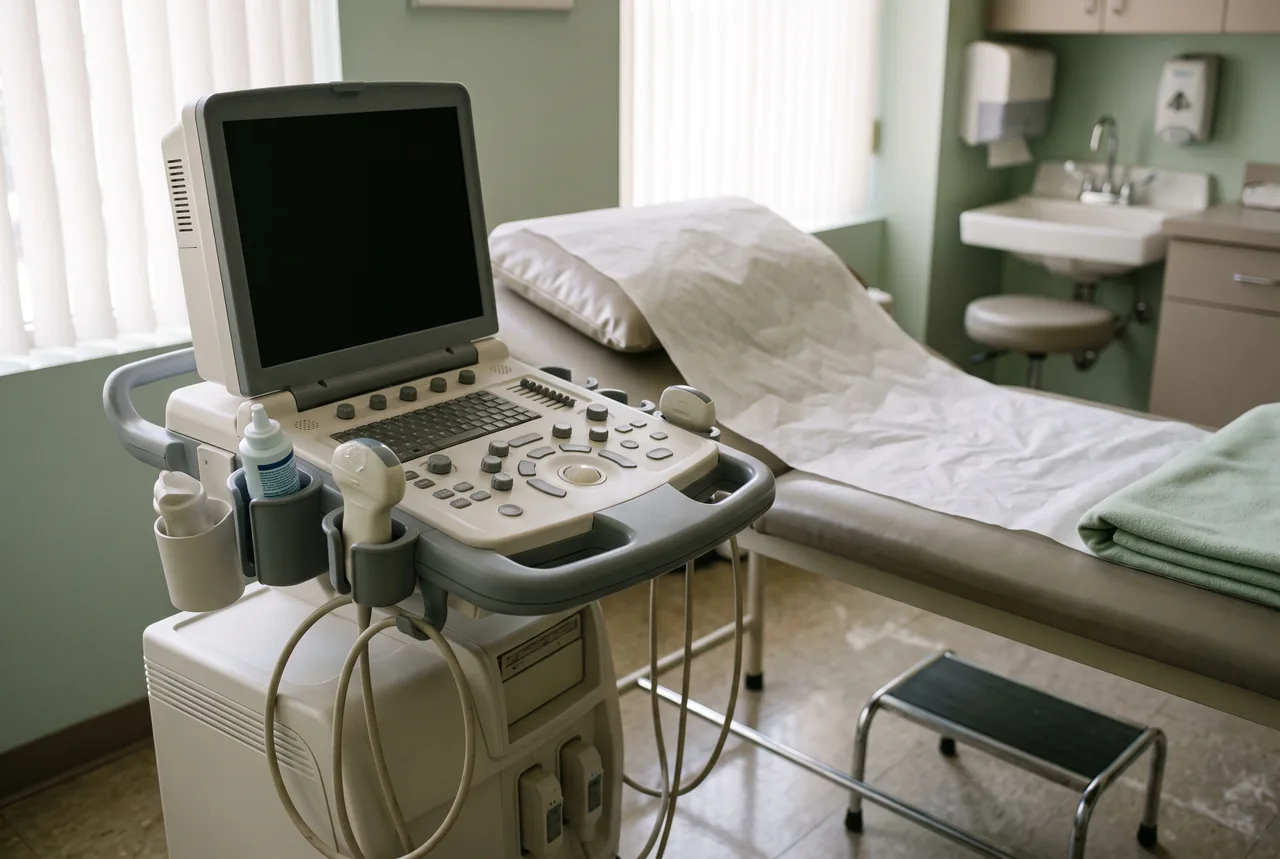
Google’s October 6, 2026, interview highlights prenatal ultrasound research whose July study found that artificial intelligence could estimate pregnancy age within a preset accuracy margin. The work involved Northwestern Medicine and Jacaranda Health, using scans collected by operators with no previous ultrasound experience.
The approach uses predefined sweeps across the abdomen to collect ultrasound images for AI interpretation. Its validated task was estimating gestational age, meaning how far along a pregnancy is.
The AI model’s average absolute error was 4.2 days, compared with 4.5 days for the standard clinical procedure. This measure counts the size of each error, whether an estimate is too early or too late.
The result met a predefined one-day “noninferiority” margin: the limit for how much worse the AI could perform while meeting the study’s comparison goal. That supports comparable accuracy within the chosen margin; the lower average error alone does not prove the AI is better.
Novice operators received different training
Five operators had no previous ultrasound experience. Chicago operators received written and verbal instructions plus a brief demonstration. Nairobi operators received six hours of hands-on training.
The findings therefore reflect scans gathered by novices with different preparation, rather than a single training program. That distinction matters when assessing what the research establishes about operator training.
The primary accuracy evaluation included 385 participants at 16–36 weeks of pregnancy, drawn from a broader cohort of 2,043. Researchers separately used data from 120 Chicago participants to adapt the model.
Those groups served different purposes. The reported accuracy comparison applies to the 385-person evaluation, so the larger enrollment should not be read as the number tested for that result.
Pregnancy dating has a narrower evidence base
Google also says the system can identify fetal presentation—the baby’s position—as accurately as a trained sonographer, an ultrasound specialist. The July study validates pregnancy-age estimation and explicitly places other pregnancy findings outside that validation.
Google funded the study and participated in its design and analysis. Independent editorial coverage reported the research results but did not provide a separate clinical evaluation.
For patients and clinicians, the supported finding is specific: AI estimated pregnancy age from novice-collected scans within the study’s accuracy threshold. These results do not establish improved patient outcomes, and broader pregnancy assessments require their own validation.
Share this story
Related Stories

Los Angeles County Plans Hospital Financial-Aid Screening Before Bills Arrive
A shared system could help eligible patients receive hospital financial aid without an application. It remains under development, with hospital participation and long-term funding unresolved.

England’s NHS treatment backlog reaches 7.4 million outstanding care pathways
Around 6.2 million people were waiting for planned care in August. Record summer activity has not prevented the backlog from growing, according to BBC reporting.

Wabi opens public access to AI assistant with shared chats
The free service shifts from user-requested mini-apps toward an assistant that builds tools inside conversations. Its business model is still undecided.

Amazon opens TorchNeuron beta to ease PyTorch use on Trainium
Amazon says developers can move PyTorch applications to Trainium with a basic configuration change. A separate open-source release is planned for Tuesday.
See an error? Request a correction.